The 2024 LinkedIn Green Skills Report estimates that we need to DOUBLE “green skills” in the workforce in order to meet our climate commitments. “Green skills” can actually mean a lot of things. Traditionally, many folks think it means studying or working in the environment directly, for example as a marine biologist or with a non-profit planting trees. But there are many other ways in which professional skills can translate into the growing field of Climate and Sustainability. In this blog I will be sharing my own journey to Sustainability Professional.
Educational Background:
After graduating high school in Jefferson County, West Virginia, I went on to attend West Virginia University in Morgantown. As a freshman, I was torn between majoring in photography, or something which involved math since I was always good at that. My dream job at the time was to become a photographer for National Geographic, traveling to remote places to capture exotic animals on film. With the encouragement of my parents, I ended up majoring in Engineering. Specifically, Industrial Engineering. If you don’t know about IE, it’s essentially engineering of processes, usually in a manufacturing plant but also business processes. How do you tweak materials and machines to minimize defects? How do you cross train employees to maximize their utilization? How do you reorganize a process to get it done in half the time? I enjoyed this area because I felt like it was applicable to many different industries and wasn’t as technical as something like electrical engineering.
First Job out of College:
I didn’t have a job lined up after graduation, so I spent the summer working odd jobs and “applying for jobs like it was my full-time job.” I remember it being a hopeless and ultimately fruitless task. Eventually, though, a family friend landed me an interview in Maryland at a manufacturing plant for a large biopharmaceutical company (biopharmaceutical: pills and tablets, and injectable medicines.) I was hired as a temporary employee on the Operational Excellence team. After a few months, I earned a full-time position as a Lean Six Sigma Specialist, a position that was right in line with the skills I gained through my degree.
Working in Biotech:
I ended up working for that same company for over 10 years. I progressed in seniority on the Operational Excellence team, and also held positions as a facilities engineer and eventually a regional Sustainability Lead. In addition to learning about biotechnology science and processes, I learned many other skills that helped me broaden my sphere of knowledge and impact. I learned about Standard Operating Procedures and compliance. I learned about defining metrics and KPIs. I learned about strategic governance. I learned about the inner workings of some of the most complex and energy-intensive facilities out there. And I learned about corporate sustainability reporting, greenhouse gas accounting, and broader movements like water stewardship.
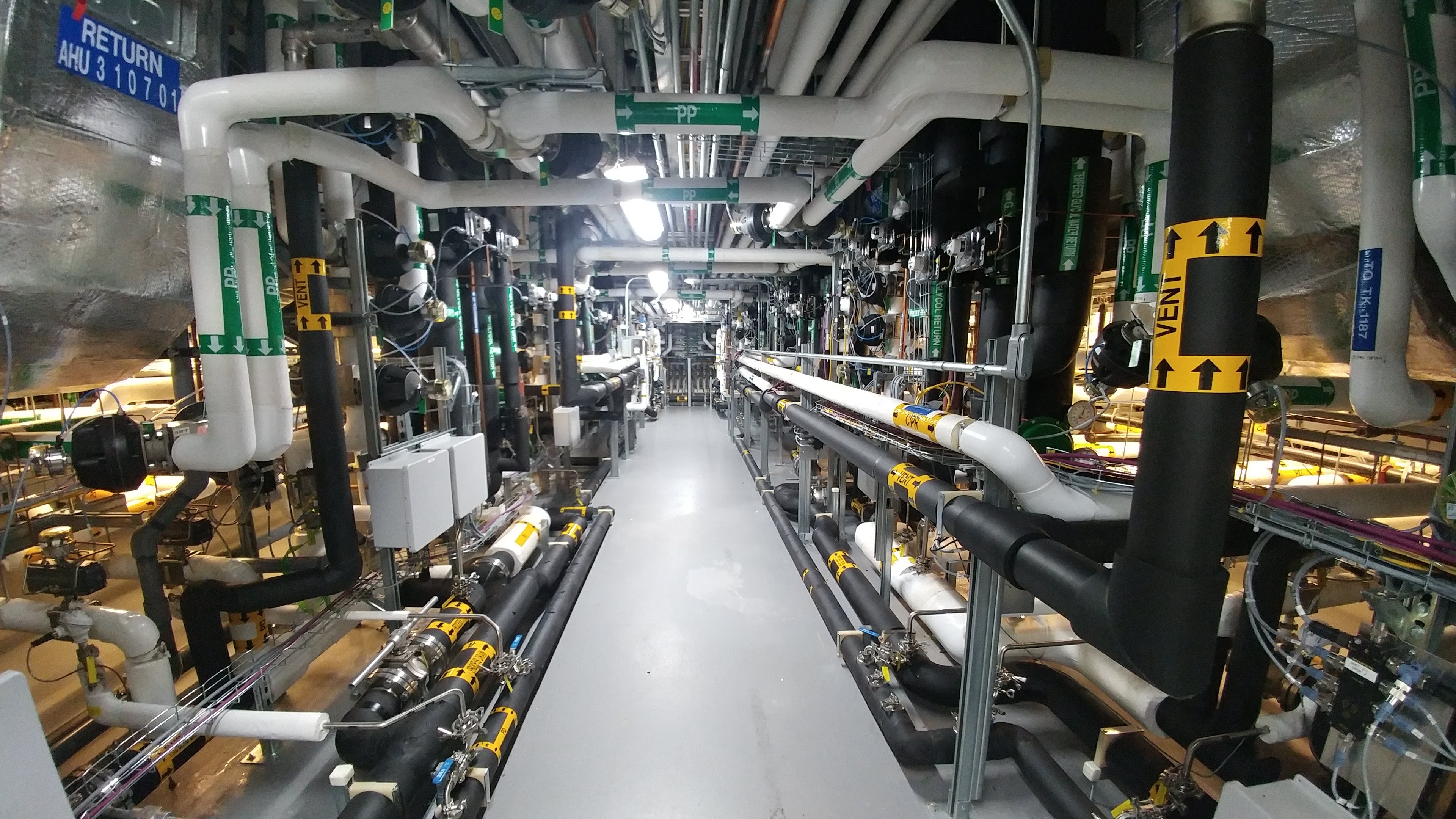
Biotech plants are....complicated!
Translating into Sustainability:
I was always involved on the employee "Green Team" and folks knew about my passion for environmentalism. When a Sustainability role opened up, this helped me get that role. My work in biotech enabled me to learn about and practice the technical aspects of sustainability in the manufacturing industry: facility efficiency, energy mix, product design, and transportation. I also learned about the more strategic and administrative aspects: developing a Sustainability program, Environmental Management Systems, sustainability reporting. There were a lot of other “corporate America” skills that contributed to my professional success as well: working with senior stakeholders, presentations, risk management, development. While working for a Fortune 500 company, I watched (and contributed to) the growth of our own sustainability maturity over the years. Then I saw how we used our buying power to put increasing requirements on our suppliers to drive more sustainable practices down the supply chain.
Entrepreneurship:
Seeing this trend- trickle down sustainability requirements- not only at our company but also at other large companies was what inspired me to start my entrepreneurial journey as a Sustainability Consultant. For now I am freelancing, working with a few clients on things like implementing Environmental Management Systems, B-Corp certification, greenhouse gas reporting, and energy efficiency projects. It has been an exciting journey thus far and I am very grateful for my time in biotech which prepared me for this step in many ways. Of course, there is always something new to learn and master, either in Sustainability or as an entrepreneur; there is never a dull moment!
In conclusion, I would like to share a quote from the 2024 LinkedIn Green Skills Report.
“Every climate goal around the world, every commitment made, is at risk if we don’t have a workforce that can deliver the change we urgently need. The economic opportunity is there and a promising skills-based pathway exists. This year is an inflection point for our planet- and for workers- as countries and companies write new climate commitments; they must include explicit investments in the green workforce.” - Sue Duke, VP of Public Policy and Economic graph, LinkedIn
Green job examples:
💡 Sustainability Manager / Specialist / Analyst
💡 Director of Sustainability
💡 Solar Installer / Consultant
Green skills examples:
💡 Building Performance
💡 Health, Safety, Security, and Environment
💡 Electrification
💡 Responsible Sourcing
💡 Sustainability Reporting and Greenhouse Gas Accounting